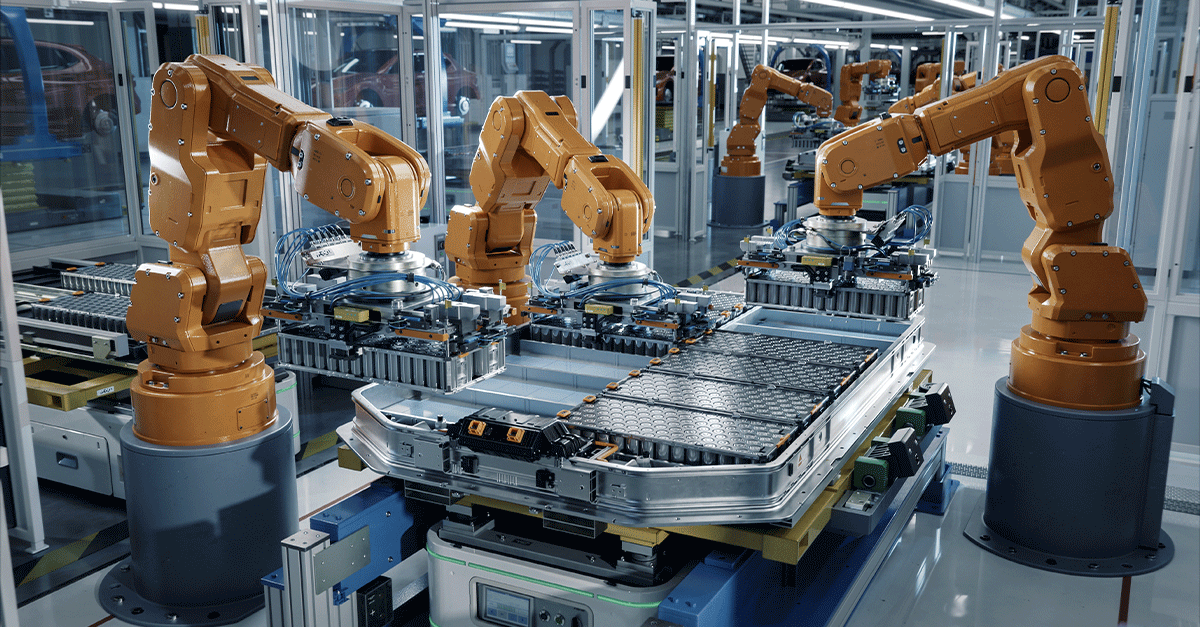
How Avery Dennison’s R&D teams are helping the automotive industry address EVB challenges
Research and development is crucial to address the challenges posed within the electric vehicle battery sector – and Avery Dennison is constantly pursuing new avenues to meet customer demands. In this article, we find out more about Avery Dennison’s unique strategic approach to R&D for its performance tapes and labels, and how it’s benefiting their customers in the EVB sector. As well as giving an overview of the company’s approach to R&D, we hear from two staff members who are directly involved – Dr Stijn Coertjens, Senior R&D Project Leader for Performance Tapes Europe, and Mutlu Cavusoglu, Director of R&D for High-Value Segments for Labels and Packaging Materials Europe.
Finding answers for unique EVB challenges
The marketplace for EVBs is both young and rapidly growing, and that makes it very different from other sectors. Stijn starts by explaining the two main consequences of this: “First, it means that many of our customers are still learning about the fundamentals of the technology, while at the same time having to adapt to emerging developments. So as a result, they sometimes need help to work out exactly what they need, and to understand what solutions they could be considering”.
The second aspect, explains Mutlu, is that there is no global industry standard on how to test the performance of EVB materials. “The result is that every customer carries out any given test using their own preferred method, which is quite likely to yield a different result from another one”, he says. Consequently, he explains, any product has to be developed with an understanding of how it will ultimately be assessed, and which standards will be used to judge compliance.
Both these factors mean that there are no easy answers to addressing customer challenges, whether it’s supplying insulating laminates for thermal control in the EV battery pack, or designing component-identification labels able to withstand extreme conditions. “When it comes to performance tapes and labels for EVB, every request is treated as an individual project”, explains Stijn.
Working alongside customers at every stage
This is part of what makes Avery Dennison different from other manufacturers – and another aspect is their collaborative approach. In the majority of projects, the R&D teams for each business unit work closely with the internal application experts and OEMs, who know the sector and can understand and interpret the customer’s needs. It’s then the job of Stijn, Mutlu and their colleagues to translate those needs into material design requirements, engineer them, and bring them together to form the end product. Quite often that will involve using ideas developed for other products or even other industries: “We’re very strong on sharing information and expertise, so we can build on past successes and keep up to date with the latest trends”, says Mutlu. And that's just the start of the process.
"Our production processes are very flexible, so we’re well set-up to adapt to customer requirements, such as accommodating modifications to the production method."
Avery Dennison also has pilot plant facilities to scale-up a process and assess that it’s ready to go to full-scale production. In addition, it has laboratory technicians to analyze material quality and test performance at various stages. “In every case, we’re all working as a team to deliver what the customer is asking for”, says Mutlu.
Cross-continental R&D expertise
Across Avery Dennison, there are R&D staff with a wide range of specialities – primarily in the fields of polymer science, adhesive technology and material engineering, but also in specialist topics like polymeric films and functional coatings. This allows them to provide solutions to any materials-based challenge they’re presented with.
The R&D effort at Avery Dennison is also cross-continental, with a network of staff distributed across the company’s main sites in the USA, the Netherlands, Israel, Brazil, India and China, as well as other regions. This, says Stijn, allows them to provide expertise tailored to regional markets – which can vary because of different regulations, standards, or manufacturer preferences. It also ties in nicely to their production effort, allowing the company to manufacture the final products close to where they are needed. “Customers like that because it cuts a lot of transportation costs and boosts the sustainability of the products”, he points out.
Tackling ambitious long-term objectives
There’s a strong element of forward-thinking about Avery Dennison’s R&D approach too. Mutlu explains why: “With EVBs, you’ve got to have your eye on what might be coming five or ten years down the road, because you need to start planning for that now! So we use our own business intelligence, plus what customers tell us, to devise our long-term R&D objectives”.
However, many of the long-term goals, says Stijn, would be too much to tackle in one go – so they’re broken down into shorter-term projects, which can be completed within one or two years: “ That means it’s easy to make measurable progress towards the long-term strategy, while also remaining agile if priorities change”, he explains.
Fresh thinking on tapes and labels
And the benefits of this multi-pronged, collaborative and strategic approach to R&D are visible everywhere you look at Avery Dennison.
On the performance tapes side, the R&D team has developed materials for general bonding of battery pack components. One example of this is tapes that are used as assembly aids during production, prior to mechanical fastening. They’ve also developed highly specialized laminates to enhance electrical insulation and thermal management. “Laminates like these are always tailored to the application”, says Stijn. “A good example of this is our constructions used to attach cooling plates, which are adjusted to achieve exactly the right level of cooling for a particular battery pack design”.
Labels are also a vital aspect of EVBs – not just to provide safety information or identify parts during production, but to serve roles further down the line, for example when parts need to be repaired, replaced or recycled. Mutlu explains: “Our customers want to be able to track every component, and the label integrity needs to be assured for the entire lifetime of the battery, in all conditions that it might be exposed to. That requires some serious research and engineering effort from R&D”. A recent example of this, he says, was labels that provided identification, warning and tracking information. Although they met the chemical resistance requirements for electronic and automotive applications, they needed to be re-designed to meet the additional UL 94 flammability test for the company’s EVB customers – so the team developed a modified construction with a flame-retardant topcoat.
Navigating to the future of EVBs with Avery Dennison
Stijn and Mutlu say that the work that the R&D staff do for Avery Dennison shows not just in the products themselves, but in the service provided to customers. “Within the industry, it’s my belief that we stand out from the rest in terms of our knowledge of materials science and digital technologies”, says Mutlu. “Added to that is our willingness to adapt to customer requirements. So we’re not developing products just because we think they’re exciting or interesting – our main motivation is in addressing unmet needs from our customers, and we’re ready to work together to find a solution”.
This connection throughout the development process also makes ongoing collaboration more productive, adds Stijn.
"If our customer later has a question about a product we’ve developed together, we can get straight to the point, and find an answer far more quickly. It’s that level of service that they really appreciate."
All this, combined with the company’s scale and global reach, means that the R&D staff at Avery Dennison are leading the way in addressing future needs in the EVB sector. The challenges are numerous – improving EVB performance and safety, boosting sustainability, pushing forward on digital component identification, and taking account of ever-tighter chemical regulations. But Stijn, Mutlu and everyone else involved in R&D at Avery Dennison are ready to take on these challenges, and show how to navigate a route to ever-better EVBs.